VIDEO SUMMARY
If you’re a content creator or what I call a Creative Conductor, you’re facing two big challenges right now:
1. Learning fast.
2. Turning that learning into consistently valuable content.
In this video, I walk you through the exact 5-step system I use to capture ideas, sharpen my point of view, and use AI tools like ChatGPT strategically — without falling down endless research rabbit holes.
If you want to think better, create smarter, and build real authority in today’s AI-driven world, this one’s for you.
Recommended AI tools for business growth:
http://AItools4biz.com
Listen to this and other episodes on our podcast:
https://bit.ly/sre_podcast
TIMESTAMPS (Chapters)
0:00 Hook – The 2 biggest challenges we face as creators
0:28 Capture ideas immediately – Why your brain won’t remember that “brilliant thought”
1:05 Earl Nightingale’s “stab the idea” principle – Lock it in fast
1:28 Using quotes correctly – Add your POV for authority & GEO/AEO
2:23 Generative Engine Optimization explained – Why being cited matters now
3:06 Step 2: Record everything – Why voice beats typing
4:12 Building your idea system – Google Docs & spreadsheets
5:34 Step 3: “Terry-ize it” – Developing your unique voice
7:14 Step 4: Using ChatGPT, Gemini & Grok wisely
8:29 Perplexity commercial use warning – What you must know
9:48 Step 5: The “Doggy Draft” method – Embrace rough iterations
10:54 Live ChatGPT voice demo – Iteration and balance
12:02 Avoiding research rabbit holes – The boomerang strategy
13:18 Why ChatGPT voice + deep research is a creator superpower
14:09 Audio brain dumps – Multi-modal learning for retention
DETAILED BREAKDOWN
The Two Core Challenges We’re Facing
Let me start with what I see over and over again:
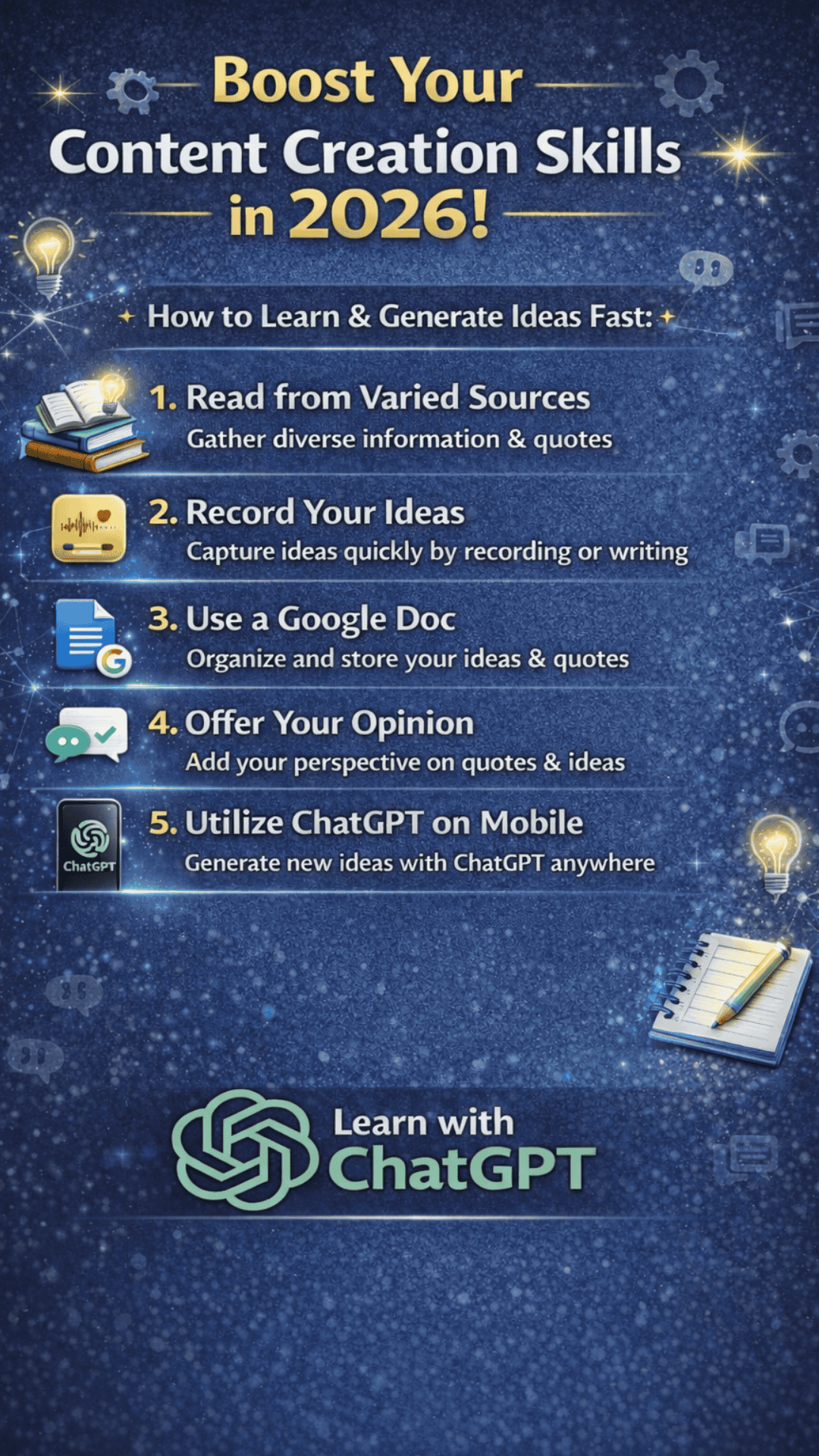 • We need to learn relevant material quickly.
• Then we need to turn that learning into meaningful content.
In today’s world of Generative Engine Optimization (GEO) and Answer Engine Optimization (AEO), simply repeating quotes isn’t enough.
You and I have to interpret, analyze, and add our own perspective if we want to stand out and actually be cited as an authority.
Step 1: Capture Ideas Immediately
I was heavily influenced by Earl Nightingale’s advice to “stab the idea.” When an idea hits you, capture it immediately.
Don’t trust your memory. It can forget way too often.
Have you noticed that? I certainly have.
Write it down — or even better — record it by voice. When you speak it out loud, you activate multiple learning modes (visual, auditory, kinesthetic). That boosts retention and clarity.
Make it your habit to regularly voice record ideas and thoughts.
Waiting to “remember later”? That doesn’t work. Systems do.
Step 2: Build Your Personal Idea Collection System
Here’s what I do in the real world:
• Highlight digitally (Kindle or eBooks)
• Dump ideas into Google Docs
• Maintain a spreadsheet to track insights
• Record voice notes for speed
This creates a searchable content vault so I’m never staring at a blank screen wondering what to talk about next.
I’ve found Google Docs works very well for this.
I also regularly use CastMagic to grab ideas for me.
Step 3: Develop Your Unique Voice (“Terry-ize It”)
Authority doesn’t come from repeating quotes.
It comes from interpreting them.
I encourage you to insert your worldview — where you agree, where you disagree, and what you’ve experienced personally. That’s how you build distinction instead of sounding like generic commentary.
Step 4: Use AI Research Strategically (Without Getting Stuck)
I use tools like:
• ChatGPT (especially voice + deep research)
• Gemini & NotebookLM
• Grok
• Perplexity
They can dramatically enhance learning and content creation — if you use them wisely.
But here’s the key: understand the terms of service, especially around commercial use. And whenever you cite research, go back to original sources.
AI is a thinking partner. It’s not a replacement for your judgment.
Step 5: Create a “Doggy Draft”
Perfectionism will kill your momentum.
My “Doggy Draft” method is simple: get the rough, rough draft out first. Don’t worry about grammar, spelling, or polish. Just move the ideas from your head into editable form.
Multi-Modal Learning for Faster Mastery
Here’s what I recommend:
• Do audio brain dumps
• Transcribe into text
• Read and listen to reinforce retention
When you combine modalities, you strengthen comprehension and accelerate creative output.
Join the Conversation
How do you capture ideas and avoid research overwhelm?
Tell me in the comments — I’d love to hear your workflow.
And if you’re serious about growing as a Creative Conductor, come explore more with us at Stark Raving Entrepreneurs.
Let’s build something meaningful.
For your convenience, here’s a transcript of this episode:
Terry Brock [00:00:00]:
Two of the biggest challenges we have as content creators, as creative conductors, is learning how to learn fast. Material that’s really relevant using that. And, also, when we’re creating, what you do, I’m gonna give you five steps on that. I’m gonna show you how I use Chat ChatGPT on my phone to get some ideas and that you can use as well. Let’s get right into it here. First of all, you wanna start reading a lot from a variety of sources. When you see a quote, when you see something you think, hey, I can use that. By all means, get it down.
Terry Brock [00:00:28]:
Get it recorded. Don’t do like my brain sometimes says, oh, I’m driving along, for instance, classic. Driving along listening to something, I go, oh, that’s a great idea. I’ll remember that. Yeah. Right, Terry. It’s out of there. So what you wanna do is you wanna record it.
Terry Brock [00:00:44]:
Get it down right away. One of the things I remember from the late great Earl Nightingale, man who was considered the dean of personal development. He said, when an idea comes, you wanna stab it. And what he meant by that was take a pen and paper. Remember that? Yeah. We used to use well, I’m doing that right now here with this. Use my paper here, and I got the pens and writing it down. But when you get an idea, you wanna grab it.
Terry Brock [00:01:05]:
And I find that helps a lot. As you’re writing it down cognitively, it seeps in a little bit better. When you write it down, also, you’re bringing in the writing, you’re seeing it, And maybe you’re talking to it as well, so you’re getting the auditory capability. All those different learning modalities. Really good. So as you see it, grab that. And you wanna start using more quotes when you’re doing something. Here’s a quote, but don’t just put it in there and go, yes.
Terry Brock [00:01:28]:
That’s a nice little quote. Oh, yeah. Okay. Good. What you want is you want to be able to say, I like what she said about this. And the reason is because of a, b, and c. Now you’re giving your opinion in there, not just saying famous person said this. Or you might say, I hear what they’re saying on that.
Terry Brock [00:01:48]:
I take a little different point of view, particularly on what they said about this. This is where Google is now looking. The old days, I mean, long, long ago, like 2025, we were looking at where things were, then, and it’s a little bit different today. It’s not just a matter of being cited with the references. I’ve put some videos out on that, here that talk about what they’re looking for now with generative engine optimization. That’s what you want. You wanna make sure that you’re doing that. And then the answer engine optimization, so you’re looking at what’s going on right there, not just a search engine.
Terry Brock [00:02:23]:
Right now, many things are being done on the website. People don’t even go over to other sites. What you wanna do is be cited as an expert so that people say, hey. When you wanna know about Ookey Waggers work with me on this. Okay? Ookey Waggers, well, then the person for that is John over here or Mary over here or Tanisha. She really knows this stuff well. Okay. Fine.
Terry Brock [00:02:46]:
Then you’re sighted, and that’s where this engine start looking at it. So that’s the first step. You wanna put that in there. I’m gonna give these five. And then I wanna show you how I did use chat g p t to do this with actual conversation. So I’m gonna do that. Step number two, record some or all of your ideas. One thing I would recommend, when you read something in a book, you go, well, that’s real good.
Terry Brock [00:03:06]:
I don’t know about you. I like to highlight it. I don’t do as much right now with paper books, although I do read some. I tend to prefer my Kindle because I can highlight it, and then it’s all collected in one place, and I can use it. Plus, I can carry my phone with me when I travel, and I can carry literally thousands of books so that I can tap into something. When I’m there in a hotel room and it’s a quiet evening in the hotel room, and I can relax and I can read some things, I like doing that as well. But I encourage you, get those down. As Earl Nightingale said, you stab that idea, you get a hold of it.
Terry Brock [00:03:40]:
And matter of fact, one of the things I would recommend, instead of writing it down, I would strongly recommend you record it. Get a system set up for you so that you can quickly talk it into your device, because we can talk faster than we can type or write, both of those. Talking is better. So you wanna get something set up, you can do it. Fortunately, with most phones today, you can do that. I’ve got a spreadsheet set up where I collect ideas and what I need to do. And in that Google spreadsheet, I just, oh, I got an idea. I need to do that.
Terry Brock [00:04:12]:
And I’ve learned, don’t just say, yes. I’ll remember it, Terry, because I don’t remember. I don’t know about you, but I have problems with it. So what I do is I go in there and I say, alright. Tap into it. Then I say, be sure and contact so and so, or here’s a great quote. And I have a Google Doc where I can put a lot of ideas that I just dump in there. So that then when it comes time to create something, I just go over there and get the information.
Terry Brock [00:04:38]:
That way it’s a whole lot better than me trying to think, gee, what am I gonna do? And somehow the ideas aren’t there. I’ve been creating content since actually, when I was back in high school. Actually, even in grade school, I was doing some things in second and third grade, writing some things down. In high school, I was on the paper there and worked for some other papers in the community. And undergrad degree was radio, TV, and newspaper. So I know a little bit about these things, but I find that when I can write it down, I work better. How does that work for you? Please leave a note in the comments wherever you’re getting this, this content. Might be on YouTube, might be with the podcast form, might be over on LinkedIn, or might be on Substack.
Terry Brock [00:05:13]:
We love Substack. Oh, great little tool. Lots of good things that are there. But I’d love to hear from you on how you do that. So that’s number two. Number three, you wanna share your point of view. This is what I call you I z e. You I z e and put your feeling, your ideas into it.
Terry Brock [00:05:34]:
I like to say, let’s say your name is John. Well, you would want to John ize it. Or if your name is Betty, you would want to Betty ize it. And as I often like to say, I’m Terry, so I like to Terry ize it. Sounds kinda cool that way. You know? Not everybody can do that, you know? So I put it in there. Let’s Terry ize it. But I want you to put your feeling in.
Terry Brock [00:05:51]:
What do I mean by that? You’re gonna put in your ideas, your ideas where you agree, where you disagree on this. And I think we need to have more of that in our society, not arguing and shouting at each other. No. But embracing what we talk about here at Stark Raving Entrepreneurs, live and let live. I don’t see anything wrong with that philosophy. You live your life, do whatever you want to do, anything, as long as, there’s this important thing, you don’t harm others, You don’t take their stuff. Okay? You don’t harm others. You don’t take their stuff.
Terry Brock [00:06:25]:
You keep your word. You say you’re gonna do something. You do it, and this is how to do it. I think our world would be better if we did that. And so in creating content, put out content from different points of view. I don’t know about you, but I’ve changed my view through life quite a bit. Matter of fact, this next week coming up, got one of those major birthdays coming in. One of the kind of birthdays that you say, when the heck did that happen there? I don’t know.
Terry Brock [00:06:49]:
But it’s there, there. And I’m looking forward to it and getting into it with gusto. But I want you to record these ideas. As they come to you, you put them down there, and you put in your own feeling, your point of view in there. So then it’s unique. Number four, you wanna ask chat g p t or your other LLMs that you’re using. I’m using Gemini, love it to pieces. Grok, I really love.
Terry Brock [00:07:14]:
Got lots of good things there. I’ll also use perplexity. Claude is also very good. There’s several that are out there. I recommend that you have one or two that you can really be comfortable with and generally a third one because you’ll sometimes get different points of view. So you wanna do that. You wanted to ask chat g p t to do some research. Now here’s where it starts sparkling because it’s one thing to hear from Terry.
Terry Brock [00:07:39]:
This is what I believe about this. Okay. That’s nice. But what’s the research saying? And this is where ChatGPT just recently, as we’re doing this recording, improved their voice capability so that you can interact even better. I’m gonna let you see an example of that in just a little bit here. It is really good if you’re using that. I’m using I’m using the paid version, $20 a month, so I can get a little bit more that way. And then also in their research, the deep research that you can get from ChatGPT, also from Gemini.
Terry Brock [00:08:09]:
Gemini has some really good research capabilities. And their NotebookLM, fabulous tool. Notebook l m is a tool that I’d recommend strongly. Take a look at it. We’ve got some videos on that that we put together. People are loving it. So looking and seeing what it can do and how it’s helping them. But then doing that deep research and also perplexity.
Terry Brock [00:08:29]:
Perplexity really sparkles when it comes to the labs. Or they used to call it labs. Now they’re calling it, something else, but it’s the the research that they have within perplexity. They do a lot with it. However, disadvantage of using perplexity, if you’re not using their 200 a month program, you are not officially allowed by their documents, their terms of agreement, to use it in a commercial venture. That’s right. This is just a side note, but really important between you and me as content creators. Careful.
Terry Brock [00:08:59]:
Because if you get a bunch of ideas and you wanna put that in from perplexity, not if you’re going to use it in business. That’s perplexity. Other LLMs will let you do that. You can use it yourself, but what you can do this is not working around. It’s what I got from Chad from perplexity himself. You might find a reference. You go, oh, I really like this one. Go over.
Terry Brock [00:09:19]:
Read the original document. Then you could refer to the original document to say this was cited by professor Smith and professor Jones at the University of Eastquackajougah or whatever. You know, put it in there, and that would be one way to work with it. Anyway, that’s something to be aware of, very important when you’re using it. And then fifth, I recommend that you put together a rough rough draft. Now I say, me being the nerd that I am, this is what I call my doggy draft. You know, you get it? Rough rough. Oh, okay.
Terry Brock [00:09:48]:
Work with me on this. Alright. You know, it’s it’s me. I’m a nerd. My brain works that way. But, I like to look at it. Don’t this is where I just do a verbal talk down. I’ll either get my microphone here and do it, or I’ll do it on my phone, be able to just do a brain dump.
Terry Brock [00:10:03]:
I’m not worried about correct grammar. I’m not worried about spelling. I’m not worried about, saying something that I go, and that’s not exactly what I meant. I meant more like this. It’s just a way to get the ideas from here up in my little noggin from bouncing around up there down onto something where I can operate on it. For me, that means Google Docs. I like to use Google Docs and get it down there in print so I can use it. Sometimes I’ll go directly into Google Docs, and I just do a brain dump of the ideas.
Terry Brock [00:10:30]:
So those are the five steps that you wanna use. Using those, you can do a lot. And so I was asking Chatt GPT about that. And I said, okay. What do you think about this? And how can we do it? And I asked him to get some, information. I told him him, I’m calling him, what I basically did there and then came back with this. So let’s see what he had to say as I talked to chat GPT about this.
ChatGPT [00:10:54]:
I like where you’re going with this. It’s a nice little learning content creation loop. It’s reflective and layered, which is a solid approach for both internalizing knowledge and producing thoughtful content. Now, a dose of reality.
Terry Brock [00:11:04]:
Here we go.
ChatGPT [00:11:04]:
Be ready for that rough draft to feel rougher than a cat’s tongue sometimes, but that’s where the magic of iteration kicks in. The key is balance. Don’t get lost in endless opinions, and don’t let perfection freeze you. Your doggy giraffe won’t bite. Overall, these steps are practical and flexible. Just be careful not to get stuck in step four, swimming in endless research. Keep moving forward, and you’ll keep learning and creating.
Terry Brock [00:11:27]:
Okay. That’s really important. And be careful you don’t get lost in those endless hunting around. And I told actually put that in there as a question because I said, I need your help on this. And I went back and I say, I was looking for it, and sometimes I’m going over here. And, oh, oh, that’s good, but did you see this over here? Oh, oh, oh, wait a minute. Did you see this one over here or the you know what I’m talking about, my fellow creative conductors. You know, you content creator.
Terry Brock [00:11:51]:
That’s what we go through on that. But I said, okay. How do I get around that chat GPT? And it gave me some real good ideas after I asked that. Listen to this.
ChatGPT [00:12:02]:
The classic intellectual treasure hunt where you start with triangles and end up in ancient philosophy and nuclear physics. The trick is to embrace those detours briefly, but always tie them back to your core thread. Set a timer if you need to, curiosity time, and when the bell rings, you yank yourself back to your purpose. Think of it like a boomerang, a quick arc out, but always returning to your main mission. That way, you get the bonus insights without building an actual nuclear plant in the process.
Terry Brock [00:12:30]:
Exactly. Because I joke with him. I said, we’d be like me going over here. Oh, let’s build a nuclear plant. Well, we did not study a whole lot about building nuclear plants when I went to business school. So I have, let’s say, zero expertise in that area. But I mentioned that too, and it was fun to do that. Now by the way, I want you to notice the main thing.
Terry Brock [00:12:47]:
I’m using the ChatGPT because now it’s a more fluid way of talking as if it were a real person here. Their most recent update gave us content creators some really good tools, in-depth talking back and forth. They’ve enhanced that quite a bit. Check it out on your own phone. Find out what it’s like. And you wanna use the phone version of this versus the laptop version version or if you have a desktop using that as well. You wanna make sure that you’re working with that. Those two, the deep research and the voice, real important.
Terry Brock [00:13:18]:
So I asked that about that. And then, when I said, that we’ve gotta take care of this, it came back and told me, yes. This is what we need to do. So my friends, you can learn a lot. When you get that idea and you’ve read a new book and you like it, I encourage you to keep stronger notes. Put it in there. Do a brain dump. Let’s say, when you’re not creating, but you’re just reading a good book and you wanna remember that.
Terry Brock [00:13:40]:
Create an audio file of it where you can dump it into Google Docs, then you because you can usually read faster in text than we can listen to something even if we click the speed up with learning on that. We can do that. And you can keep the audio if you’d like as well, so you have both. You can hear it and then read it. That way you’re tapping into the visual and the auditory modality. Grab the the touching and feeling modality also using some other things. So these are some ideas that I have. I wanna hear from you.
Terry Brock [00:14:09]:
It’s one thing for Terry to say, oh, this is what we’re doing, etcetera, etcetera. We can do that. And bounce over to starkravingentrepreneurs.com. Love to see you come over and take a look and see if we might be able to help you on that. Right now, we are really growing, getting a lot of people coming in for a session. We did one just yesterday, matter of fact. We were able to get some learning about substack, looking with that with some experts that came in to help us. Natasha Tynes come in talking about that.
Terry Brock [00:14:37]:
And this is something that can help you. So take a look at that, and I love to hear from you. Please let us know in the notes below in the comments what it is to you. I’m Terry Brock. I’m looking forward to hearing from you. And don’t forget, you’re gonna check out the video that’s coming up next. Got this one right over here that’s gonna help you to understand more about how we can use these tools in a practical real way. I’m looking forward to hearing from you.
Terry Brock [00:15:02]:
Have a wonderful day.
========================
And for our Spanish speaking friends:
Terry Brock :
Dos de los mayores retos que tenemos como creadores de contenido, como conductores creativos, es aprender cómo aprender rápido. Material realmente relevante, usando eso. Y también, cuando estamos creando, lo que tú haces, te voy a dar cinco pasos sobre eso. Voy a mostrarte cómo uso ChatGPT en mi teléfono para obtener algunas ideas y que tú también puedes usar. Vamos directo a ello aquí. Primero que nada, quieres empezar leyendo mucho de diversas fuentes. Cuando veas una cita, cuando veas algo y pienses, ¡hey, puedo usar eso! Por supuesto, ponlo por escrito.
Terry Brock :
Regístralo. No hagas como mi cerebro a veces dice: oh, voy manejando, por ejemplo, clásico. Voy manejando escuchando algo y digo, oh, esa es una gran idea. La recordaré. Sí, claro, Terry. Se va de mi cabeza. Así que lo que quieres hacer es grabarlo.
Terry Brock :
Ponlo por escrito de inmediato. Recuerdo algo del gran Earl Nightingale, un hombre considerado el decano del desarrollo personal. Él decía: cuando llega una idea, tienes que apuñalarla. Y lo que quería decir era tomar una pluma y papel. ¿Recuerdas eso? Sí. Solíamos usar bueno, lo estoy haciendo ahora mismo aquí con esto. Uso mi papel aquí y tengo las plumas y lo escribo. Pero cuando tienes una idea, tienes que capturarla.
Terry Brock :
Y eso ayuda mucho. Al escribirla, cognitivamente se asienta un poco mejor. Cuando la escribes, también traes la escritura, la ves, y quizá también la hablas, así que tienes la capacidad auditiva. Todas esas diferentes modalidades de aprendizaje. Muy bien. Así que cuando la veas, captúrala. Y empieza a usar más citas cuando estés haciendo algo. Aquí tienes una cita, pero no sólo la pongas ahí y digas: sí.
Terry Brock :
Eso es una bonita cita. Oh, sí. Bueno. Lo que quieres es poder decir: me gusta lo que ella dijo sobre esto. Y la razón es por a, b y c. Ahora estás dando tu opinión, no sólo diciendo que una persona famosa dijo esto. O podrías decir: escucho lo que dicen sobre eso.
Terry Brock :
Yo tomo un punto de vista un poco distinto, especialmente sobre lo que dijeron sobre esto. Aquí es donde Google ahora está mirando. En los viejos tiempos, hace mucho, mucho, mucho, como 2025, veíamos cómo estaban las cosas entonces, y ahora es un poco diferente. No es sólo cuestión de ser citado con las referencias. He puesto algunos videos sobre eso, aquí que hablan sobre lo que buscan ahora con la optimización de motores generativos. Eso es lo que quieres. Asegúrate de estar haciendo eso. Y luego la optimización del motor de respuestas, así que estás mirando lo que ocurre ahí, no sólo el motor de búsqueda.
Terry Brock :
Ahora mismo, muchas cosas se hacen en el sitio web. La gente ni siquiera va a otros sitios. Lo que quieres es ser citado como un experto, para que la gente diga, hey. Cuando quieras saber sobre el trabajo de Ookey Waggers, trabaja conmigo en esto. ¿De acuerdo? Ookey Waggers, bueno, entonces la persona para eso es John por aquí, o Mary por allá o Tanisha. Ella realmente sabe esto muy bien. De acuerdo. Bien.
Terry Brock :
Entonces te citan, y ahí es donde este motor empieza a mirarlo. Así que ese es el primer paso. Quieres ponerlo ahí. Voy a dar estos cinco. Y luego quiero mostrarte cómo usé chatgpt para hacer esto con una conversación real. Así que voy a hacerlo. Paso número dos, graba algunas o todas tus ideas. Una cosa que recomiendo, cuando lees algo en un libro y dices: bueno, eso está muy bien.
Terry Brock :
No sé tú. Me gusta resaltarlo. No lo hago tanto ahora con libros físicos, aunque leo algunos. Tiendo a preferir mi Kindle porque puedo resaltar y luego todo está recogido en un solo lugar y puedo usarlo. Además, puedo llevar mi teléfono cuando viajo, y puedo llevar literalmente miles de libros para poder consultar algo. Cuando estoy en la habitación del hotel y es una noche tranquila, puedo relajarme y leer cosas, me gusta hacer eso también. Pero te animo, pon esas ideas por escrito. Como decía Earl Nightingale, apuñala esa idea, captúrala.
Terry Brock :
Y de hecho, una cosa que recomiendo, en vez de escribirlo, te recomiendo que lo grabes. Configura un sistema para ti para que puedas hablar rápidamente a tu dispositivo, porque podemos hablar más rápido que escribir o teclear, ambos. Hablar es mejor. Así que pon algo para hacerlo. Por suerte, con la mayoría de teléfonos hoy día, puedes hacerlo. Tengo una hoja de cálculo donde recojo ideas y lo que necesito hacer. Y en esa hoja de Google, digo: oh, tuve una idea. Necesito hacer eso.
Terry Brock :
Y aprendí, no digas: sí. Lo recordaré, Terry, porque no lo recuerdo. No sé tú, pero tengo problemas con eso. Así que entro y digo: muy bien. Lo anoto. Luego digo: asegúrate de contactar a tal persona, o aquí tienes una buena cita. Y tengo un Google Doc donde pongo muchas ideas que sólo vuelco ahí. Así que cuando llega el momento de crear algo, sólo voy allí y saco la información.
Terry Brock :
De esa manera es mucho mejor que tratar de pensar: ¿qué voy a hacer? Y de alguna forma las ideas no están ahí. He estado creando contenido desde, de hecho, cuando estaba en la secundaria. Incluso en primaria, hacía cosas en segundo y tercero, escribía cosas. En la secundaria estuve en el periódico y trabajé para otros periódicos de la comunidad. Mi licenciatura fue en radio, TV y prensa. Así que sé un poco sobre esto, pero encuentro que cuando puedo escribirlo, trabajo mejor. ¿Cómo funciona eso para ti? Por favor deja una nota en los comentarios dondequiera que recibas este contenido. Puede ser en YouTube, puede ser en formato de podcast, puede ser en LinkedIn o puede ser en Substack.
Terry Brock :
Nos encanta Substack. Oh, gran herramienta. Muchas buenas cosas ahí. Pero me gustaría saber cómo lo haces tú. Así que eso es el número dos. Número tres, comparte tu punto de vista. Eso es lo que llamo “uenizar” (Y-O-U-izar). Uenizar y poner tu sentimiento, tus ideas en ello.
Terry Brock :
Me gusta decir, digamos que tu nombre es John. Bueno, querrías Johnizarlo. O si tu nombre es Betty, querrías Bettyizarlo. Y como a menudo digo, yo soy Terry, así que me gusta Terryizarlo. Suena bastante bien así. ¿Sabes? No todos pueden hacer eso, ¿sabes? Así que lo pongo ahí. Terryizarlo. Pero quiero que tú pongas tu sentimiento.
Terry Brock :
¿A qué me refiero? Vas a poner tus ideas, tus ideas sobre dónde estás de acuerdo, dónde no lo estás. Y creo que necesitamos más de eso en la sociedad, no peleando o gritándose unos a otros. No. Sino abrazando lo que hablamos aquí en Stark Raving Entrepreneurs, vive y deja vivir. No veo nada malo en esa filosofía. Vive tu vida, haz lo que quieras, cualquier cosa, siempre y cuando, esto es importante, no dañes a otros, no tomes sus cosas. ¿De acuerdo? No dañes a otros. No tomes su cosas.
Terry Brock :
Cumple tu palabra. Dices que vas a hacer algo. Hazlo y así es como hacerlo. Creo que el mundo sería mejor si lo hiciéramos. Y así, al crear contenido, saca contenido de diferentes puntos de vista. No sé tú, pero he cambiado mi punto de vista bastante durante la vida. De hecho, la próxima semana tengo uno de esos cumpleaños importantes. De esos que dices: ¿cuándo pasó eso? No sé.
Terry Brock :
Pero ahí está. Y estoy feliz de ello y entrando en ello con entusiasmo. Pero quiero que grabes estas ideas. Cuando te lleguen las pongas ahí, y pongas tu propio sentimiento y punto de vista. Así es único. Número cuatro, pregunta a ChatGPT o a otros LLMs que uses. Yo uso Gemini, me encanta. Grok, también me encanta.
Terry Brock :
Tiene muchas cosas buenas ahí. También uso Perplexity. Claude es también muy bueno. Hay varios ahí fuera. Te recomiendo que tengas uno o dos con los que te sientas muy cómodo y generalmente un tercero porque a veces obtienes diferentes puntos de vista. Haz eso. Pregúntale a ChatGPT que haga investigación. Aquí es donde empieza a brillar porque es una cosa escuchar a Terry.
Terry Brock :
Esto es lo que creo sobre esto. Bien. Eso está bien. Pero, ¿qué dice la investigación? Y aquí es donde ChatGPT recién, como estamos grabando esto, mejoró su capacidad de voz para que puedas interactuar aún mejor. Te voy a dejar ver un ejemplo de eso en un momento. Realmente es bueno si lo estás usando. Yo uso la versión paga, $20 al mes, así que puedo obtener un poco más de esa manera. Y también en su investigación, la investigación profunda que puedes obtener de ChatGPT y también de Gemini.
Terry Brock :
Gemini tiene muy buenas capacidades de investigación. Y su NotebookLM, fabulosa herramienta. NotebookLM es una herramienta que recomiendo con fuerza. Échale un vistazo. Tenemos algunos videos sobre eso que hicimos. A la gente le encanta. Así que mira lo que puede hacer y cómo los ayuda. Pero haciendo esa investigación profunda y también Perplexity.
Terry Brock :
Perplexity brilla mucho en los labs. O antes lo llamaban labs. Ahora lo llaman algo más, pero es la investigación que tienen en Perplexity. Hacen mucho con eso. Sin embargo, desventaja de usar Perplexity, si no pagas su programa de $200 al mes, no tienes permitido oficialmente por sus documentos, sus términos de servicio, usarlo en un emprendimiento comercial. Eso es correcto. Esto es sólo una nota extra, pero muy importante entre tú y yo como creadores de contenido. Cuidado.
Terry Brock :
Porque si sacas muchas ideas y quieres ponerlas de Perplexity, no si vas a usarlo para negocios. Eso es Perplexity. Otros LLMs te dejan hacerlo. Puedes usarlo tú, pero lo que puedes hacer, esto no es hacer trampa, es lo que Chad de Perplexity me dijo. Puedes encontrar una referencia. Dices, oh, me gusta mucho esta. Ve y lee el documento original. Puedes referirte al documento original diciendo que fue citado por el profesor Smith y el profesor Jones de la Universidad de Eastquackajougah o como se llame. Ponlo ahí, y esa sería una forma de trabajarlo. De todos modos, eso es algo a tener en cuenta, muy importante cuando lo uses. Y luego, quinto, te recomiendo que hagas un borrador. Ahora digo, siendo el nerd que soy, esto es lo que llamo mi “doggy draft” (borrador perruno). ¿Lo pillas? Ruff Ruff. Oh, ¿ok?
Terry Brock :
Trabaja conmigo en esto. Bien. Sabes, soy yo. Soy un nerd. Así funciona mi cerebro. Pero, me gusta verlo. No esto es donde hago una charla verbal. Tomo el micrófono aquí y lo hago, o lo hago en mi teléfono, puedo hacer un volcado mental.
Terry Brock :
No me preocupo por gramática correcta. No me preocupo por ortografía. No me importa, decir algo que digo oh, eso no es exactamente lo que quise decir. Quise decir más esto. Es sólo una manera de sacar las ideas de aquí arriba en mi cabeza, rebotando ahí, hacia algo donde puedo operar. Para mí, eso significa Google Docs. Me gusta usar Google Docs y ponerlo ahí en texto para usarlo. A veces voy directamente a Google Docs y hago un volcado mental de ideas.
Terry Brock :
Así que esos son los cinco pasos que debes usar. Usándolos, puedes hacer mucho. Y así le pregunté a ChatGPT sobre eso. Y dije, bien. ¿Qué piensas de esto? Y ¿cómo hacerlo? Y le pedí que obtuviera información. Le dije, básicamente le expliqué lo que hice, y luego me respondió esto. Así que veamos qué dice mientras hablo con ChatGPT sobre esto.
ChatGPT:
Me gusta hacia donde vas con esto. Es un buen bucle de aprendizaje y creación de contenido. Es reflexivo y por capas, lo cual es un enfoque sólido tanto para internalizar el conocimiento como para producir contenido reflexivo. Ahora, una dosis de realidad.
Terry Brock :
Aquí vamos.
ChatGPT:
Prepárate para que ese borrador se sienta más áspero que la lengua de un gato a veces, pero ahí es donde la magia de la iteración entra en juego. La clave es el equilibrio. No te pierdas en opiniones interminables, y no dejes que la perfección te congele. Tu “doggy draft” no muerde. En general, estos pasos son prácticos y flexibles. Sólo ten cuidado de no quedarte atrapado en el paso cuatro, nadando en interminables investigaciones. Sigue adelante y seguirás aprendiendo y creando.
Terry Brock :
Muy bien. Eso es muy importante. Y ten cuidado de no perderte en esa cacería interminable. De hecho puse eso como pregunta porque le dije: necesito tu ayuda en esto. Y volví a él y dije: estaba buscando, y a veces me pongo a mirar aquí. Y, oh, eso está bien, ¿pero viste esto por aquí? Oh, oh, espera. ¿Viste esto aquí o el sabes a lo que me refiero, compañeros conductores creativos? Sabes, creadores de contenido.
Terry Brock :
Eso es lo que vivimos. Pero dije, bien. ¿Cómo me evito eso, ChatGPT? Y me dio buenas ideas después de preguntar. Escucha esto.
ChatGPT:
La clásica caza intelectual del tesoro donde empiezas con triángulos y acabas en filosofía antigua y física nuclear. El truco es abrazar esos desvíos brevemente, pero siempre conectarlos a tu hilo central. Pon un temporizador si lo necesitas, tiempo de curiosidad, y cuando suene, te regresas a tu propósito. Piensa en ello como un boomerang, un arco de ida rápido pero siempre volviendo a tu misión principal. Así obtienes los conocimientos extra sin acabar construyendo una planta nuclear en el proceso.
Terry Brock :
Exactamente. Porque bromeé con él. Le dije: sería como ir por aquí. Oh, vamos a construir una planta nuclear. Bueno, no estudiamos mucho sobre plantas nucleares cuando fui a la escuela de negocios. Así que tengo, digamos, cero experiencia en ese tema. Pero mencioné eso también y fue divertido. Ahora, por cierto, quiero que notes lo principal.
Terry Brock :
Estoy usando ChatGPT porque ahora es una forma más fluida de hablar como si fuera una persona real aquí. Su actualización más reciente nos dio a los creadores de contenido muy buenas herramientas, conversaciones en profundidad. Lo han mejorado bastante. Prueba en tu propio teléfono. Descubre cómo es. Y usa la versión para teléfono en vez de la versión de laptop o si tienes desktop, usando esa también. Asegúrate de trabajar con eso. Esas dos cosas, la investigación profunda y el modo voz, muy importantes.
Terry Brock :
Así que pregunté sobre eso. Y luego, cuando dije que tenemos que ocuparnos de esto, me respondió: sí. Esto es lo que debemos hacer. Así que, amigos, pueden aprender mucho. Cuando tengas una idea y lees un nuevo libro y te gusta, te animo a tomar notas más sólidas. Ponlas ahí. Haz un volcado mental. Digamos, cuando no creas algo sino que sólo lees un buen libro y quieres recordarlo.
Terry Brock :
Crea un archivo de audio donde puedas volcarlo en Google Docs, porque normalmente puedes leer más rápido en texto que escuchar algo, incluso si usas la velocidad para aprender. Puedes hacer eso. Y puedes guardar el audio si quieres también, así tienes ambos. Puedes escucharlo y luego leerlo. Así aprovechas la modalidad visual y auditiva. Captura la modalidad táctil y de sentimiento usando otras cosas. Así que estas son algunas ideas que tengo. Quiero saber de ti.
Terry Brock :
Es una cosa que Terry diga, oh, esto es lo que hacemos, etcétera, etcétera. Podemos hacer eso. Y ve a starkravingentrepreneurs.com. Me encantaría verte por ahí y ver si podemos ayudarte. Ahora, estamos creciendo mucho, muchas personas entrando a sesiones. Hicimos una justo ayer, de hecho. Pudimos aprender sobre Substack, viendo eso con expertos que vinieron a ayudarnos. Natasha Tynes vino a hablar sobre eso.
Terry Brock :
Y esto es algo que puede ayudarte. Así que míralo, y me encantaría saber de ti. Por favor dinos en los comentarios de abajo qué significa para ti. Soy Terry Brock. Espero saber de ti. Y no olvides, vas a ver el video que viene a continuación. Tengo este aquí que te ayudará a entender más sobre cómo usar estas herramientas de una manera práctica y real. Espero saber de ti.
Terry Brock :
Que tengas un gran día.
¿Necesitas la traducción con los marcadores de tiempo? ¡Sólo pídelo!