f you are creating content today and feeling completely overwhelmed, you are not alone. It is a feeling shared by many in the digital space, but there is a light at the end of the tunnel. The secret isn’t working harder or trying to master every single new piece of software that hits the market. Instead, the solution lies in shifting your identity.
Catch this video to see exactly what you need to do:
https://youtu.be/M87WxVG567M
In this guide, we are going to explore how to move beyond being “just” a content creator and step into a role that gives you a massive competitive advantage: The Creative Conductor. This concept, popularized by Terry Brock at Stark Raving Entrepreneurs, is about orchestrating Artificial Intelligence to solve real-world problems. By the end of this post, you will understand how to position yourself at the center of your own AI orchestra, allowing you to build a high-value business without the burnout.
The Evolution of the Content Marketplace
We are currently witnessing a massive shift in how businesses are built. In the past, the barrier to entry was high. If you wanted to build a powerful software solution or a global media brand, you needed millions of dollars in funding, massive engineering teams, and months—if not years—of development time. That was the “old way.”
Today, the barrier to entry is effectively zero. While that sounds like good news, it also means competition has skyrocketed. To stand out, you have to embrace the “new way” of entrepreneurship. We are entering an era where solo founders are building hyper-specific software and content empires over a single weekend. Even Sam Altman, CEO of OpenAI, has suggested that we will soon see a billion-dollar company run by a single employee.
How is this possible? It happens when a human stops doing the manual labor and starts acting as a conductor. When the heavy lifting of market research, data visualization, audio production, and video editing is handled by AI agents, the human creator is freed up to do what machines cannot: build community and foster deep relationships.
Defining the Creative Conductor
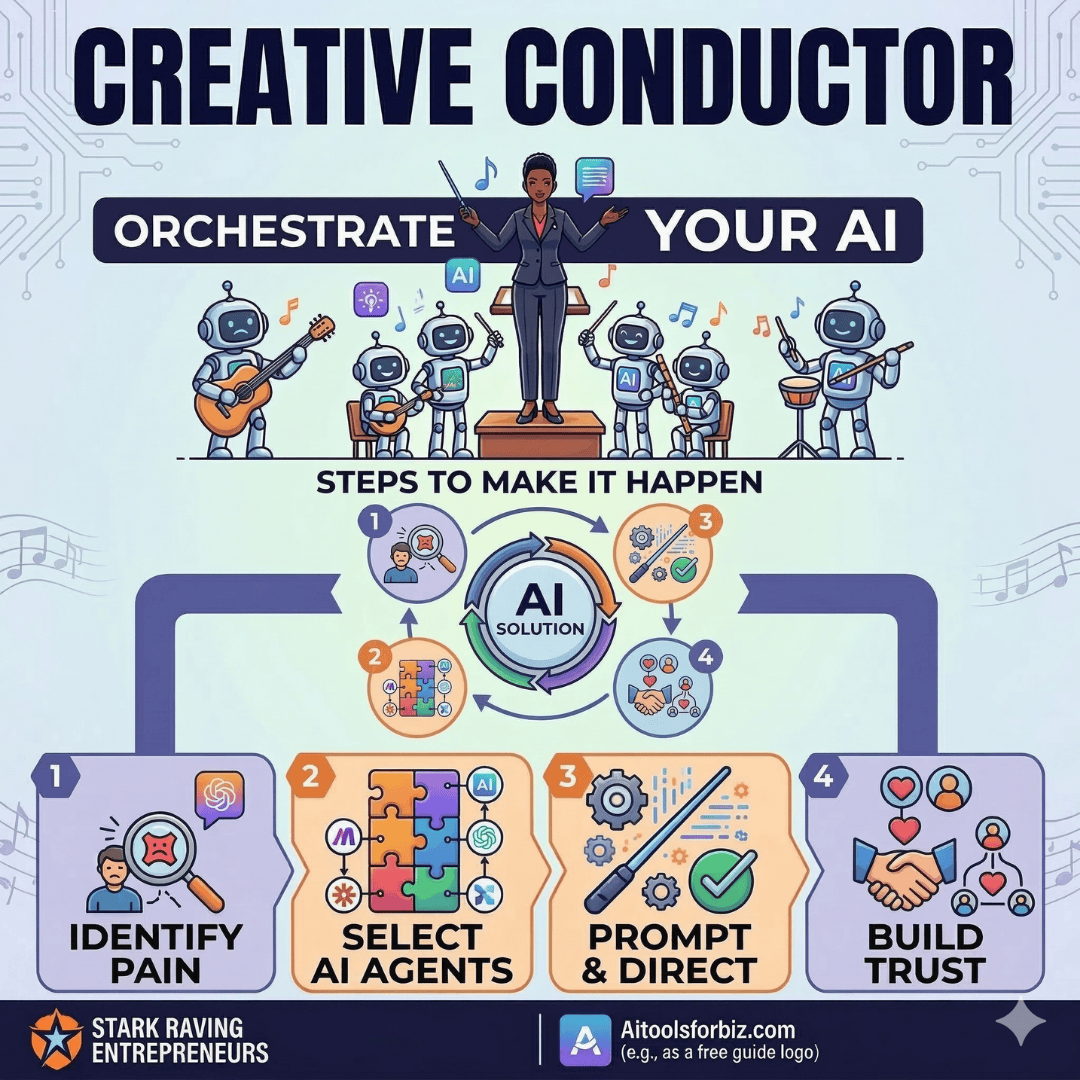
A true Creative Conductor isn’t necessarily the best programmer, the most talented graphic designer, or a world-class video editor. Instead, they are the director. Much like Lieutenant Uhura on the Starship Enterprise, the Creative Conductor is the one who keeps the lines of communication open, sends the messages where they need to go, and ensures the entire operation keeps rolling smoothly.
The Skillset of a Conductor
-
Spotting Market Gaps: You identify a specific need or pain point in a community before anyone else does.
-
Orchestrating Tools: You don’t just use one tool; you set up an “orchestra pit” of AI tools that work in harmony.
-
Masterful Prompting: You use your “baton”—the prompt—to direct the tools on exactly what to build.
-
Stitching: You assemble the various outputs from different AI agents into a polished, final product that solves a problem.
Building Your AI Orchestra
To succeed as a Creative Conductor, you need to view your AI tools as different sections of an orchestra. Each has a specific role, and your job is to ensure they play in sync. Here is how you can categorize your current tech stack:
The Strings: Logic and Writing
This is the heart of your content. These tools handle language, content generation, and deep nuance. Terry Brock highlights several key players in this space:
-
ChatGPT: The reliable powerhouse for general content and logic.
-
Claude: Excellent for nuanced writing and complex reasoning.
-
Gemini: Google’s suite of tools that integrate seamlessly with your existing workflow.
-
Grok: A tool Terry Brock personally enjoys (and as he says, you can “Grok with Brock”).
The Percussion: Rhythm and Data Flow
The percussion section keeps the beat and ensures everything moves at the right pace. In the AI world, this is your automation. Tools like Make.com and Zapier act as the rhythm section, connecting your various apps so they work together without manual intervention. They automate your workloads and keep your data in sync.
The Woodwinds: Visuals and Design
Visuals bring your creative vision to life with “stunning imagery and design.” Even if you aren’t a graphic artist, tools like Canva and Nano Banana (from Google/Gemini) allow you to produce professional-grade visuals. As Terry puts it, you don’t need to be an expert in every tool; you just need to know the right amount about the right tools to bring your vision to life.
From Manual Labor to “Vibe Coding”
One of the most exciting shifts in this new era is the move toward Vibe Coding. This concept, discussed by AI experts like Andrej Karpathy (a founding member of OpenAI), suggests that we are moving away from writing lines of code and toward orchestrating agents using natural language.
Your prompt is the new baton. When you prompt an AI, you are directing the energy and the output of the machine. This is “vibe communicating”—going with the flow of the moment and using your words to manifest a specific result. In this model, you don’t play the instruments; you let the AI agents do the playing while you focus on the “vibe” and the overall direction of the piece.
The Golden Rule: Focus on the Pain, Not the Program
If there is one trap that “geeks and nerds” often fall into, it’s becoming obsessed with the software itself. It is easy to get distracted by a “nifty and groovy” new program, but a Creative Conductor stays focused on the goal.
The real skill is sensing a community’s specific problem.
Your workflow should always follow this order:
-
Research: Use your human intuition and AI research tools to find out what people are struggling with.
-
Identify the Pain: Pinpoint the exact problem that needs solving.
-
Select the Instrument: Choose the AI tool that is best suited to solve that specific problem.
-
Execute: Orchestrate the solution and deliver it to the community.
Key Takeaways for Content Creators
-
Stop Thinking Like a Developer: You don’t need to build the tools; you need to manage them.
-
Your Prompt is Your Instrument: Improve your results by asking the AI: “Tell me what I have not asked you that I should, which will help you do a better job with this.”
-
Embrace Hyper-Specificity: Don’t try to solve everything for everyone. Solve a specific problem for a specific community.
-
Invest in Relationships: Since AI handles the manual labor, your primary job is to build community and trust.
Conclusion
The era of the overwhelmed content creator is ending, and the era of the Creative Conductor is beginning. By stepping back from the “manual labor” of production and stepping into the role of orchestrator, you can leverage AI to build a business that is both scalable and deeply connected to your audience. Remember: don’t get lost in the tools. Stay focused on the people you serve and the problems you solve.
Want to see these concepts in action? Watch the full video to learn more about how you can position yourself as a Creative Conductor in today’s marketplace!
Watch the full video: https://www.youtube.com/watch?v=M87WxVG567M