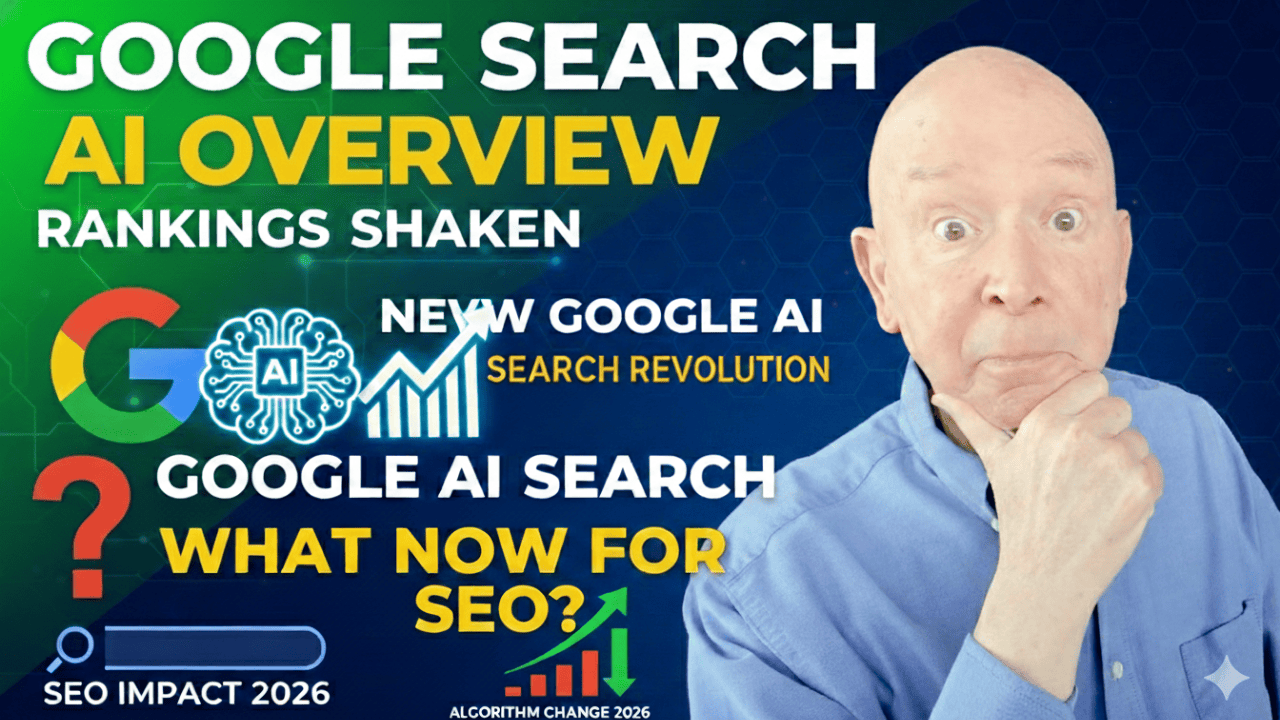
Your old “rank #1 on Google” playbook is fading fast—because search is becoming AI-driven, conversational, and increasingly zero-click.
In this video, I break down what the “Google traffic apocalypse” means for creators and business owners—and the smarter path forward: becoming the cited source AI systems reference.
This is a really BIG deal! Whoa Nellie!
Check out the video here:
Recommended AI tools for business growth.
http://AItools4biz.com
Listen to this & other episodes on our podcast
https://bit.ly/sre_podcast
Stand-out line from this episode:
“It’s not about being found. They’re gonna find you. It’s about being cited as the authority within the AI generated answers. This is the key.”
CHAPTERS / TIMESTAMPS
0:00 AI Search Is Rewriting The Rules – What to do now (and not panic)
0:27 The End of the Blue-Links Era – Why the old SEO game is changing
0:54 “Become the Source” – How citations can beat rankings
2:08 Zero-Click Search Reality – Why users aren’t visiting websites like before
2:49 Destination Search + LLM Habits – How people now “search” inside AI answers
4:14 AI Overviews & AI Mode – What Google’s Gemini-powered shift means for business
5:44 The New “See More” Button – Why Google keeps users inside Google
7:21 The Death of Position #1 – What replaces “rank first” strategies
11:41 The New User Journey – How buyers move from AI summary to trusted source
13:01 GEO (Generative Engine Optimization) – The new playbook beyond traditional SEO
14:08 The Power of Citation – Why being referenced builds instant credibility
16:25 Build Semantic Identity – How to become a recognized authority to AI
18:14 Stop Being Generic – Why niche expertise wins in the AI era
19:40 Solopreneur’s Citation Cheat Sheet – Micro-experiments, proof, and named frameworks
22:02 Your Next Steps – Resources, tools, and how to stay ahead
__________________________________________________
DETAILED BREAKDOWN
WHAT’S HAPPENING TO SEARCH (AND TRAFFIC)
Search is shifting from “click a link and read 10 sites” to “get a synthesized answer instantly.”
Key idea: if the user gets the answer on the results page, traffic drops—and the old “blue links” strategy loses power.
ZERO-CLICK DOESN’T MEAN ZERO OPPORTUNITY
I also explain the paradox: fewer clicks… but more qualified clicks.
That is actually a pretty dang-good thing!
When someone does click through after reading an AI answer, they’re often:
• more informed
• more serious
• closer to a decision
WHY “RANK #1” MATTERS LESS NOW
In the old world you know, like WAY back in 2025, position #1 could dominate clicks.
In the new world, attention concentrates on what AI surfaces and summarizes—so your goal shifts from “be first” to be trusted and referenced.
GEO: GENERATIVE ENGINE OPTIMIZATION (THE NEW SEO)
Instead of optimizing only for rankings, GEO focuses on being cited inside AI-generated answers.
This includes:
• publishing content that solves specific problems clearly
• creating expert-level depth (not generic fluff)
• making your ideas easy for AI to “quote” and attribute
THE POWER OF CITATIONS (AND WHY IT BUILDS AUTHORITY FAST)
When AI tools reference your work, it signals credibility—like an “expert witness” moment for your brand. The win isn’t just visibility; it’s positioning: you’re not one option in a list—you’re part of the answer.
BUILD A “SEMANTIC IDENTITY” AI CAN RECOGNIZE
To get cited consistently, you need to be consistently you:
• clear niche + repeating themes
• high-quality, evidence-backed content
• a recognizable framework, point of view, or methodology
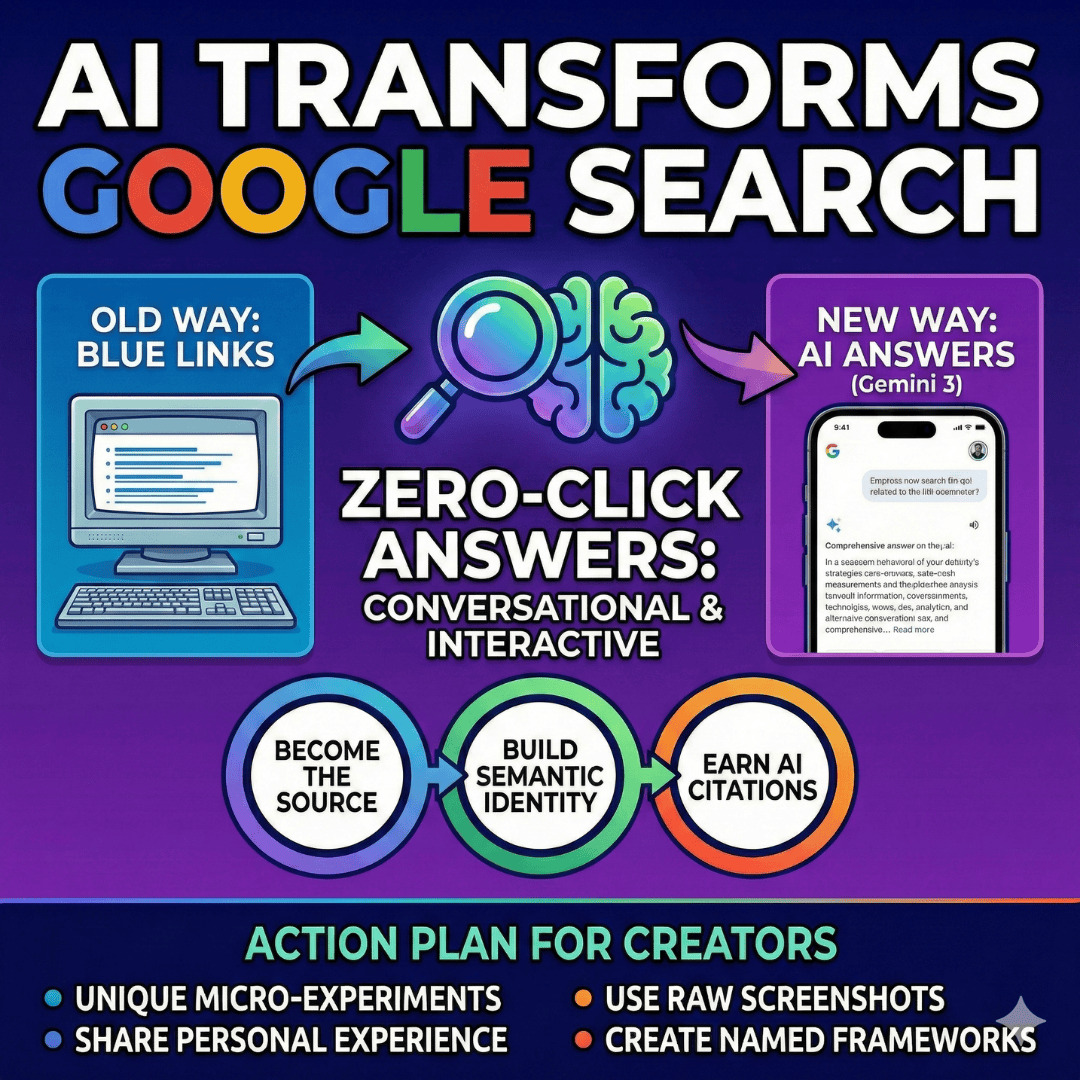
THE SOLOPRENEUR’S CITATION CHEAT SHEET (TACTICAL MOVES)
My practical suggestions for becoming more “citable”:
• Replace broad advice with micro-experiments and specific results
• Use real screenshots / raw proof (not just polished charts)
• Turn abstract goals into named frameworks (so people can reference you by name)
• Lean on AI for research—but add your lived experience and tested outcomes
NEXT STEPS + JOIN THE CONVERSATION
If you want more strategies for creators and business owners navigating AI, check the resources above—and drop a comment:
What part of AI search changes your strategy the most right now?
For your convenience, here’s the transcript for this episode:
Speaker A [00:00:00]:
Your life has just changed dramatically, so has mine and everyone using the Internet. What we used before with Google in the search has changed because of AI. It’s dramatic. A matter of fact, what we’re calling it right now is the Google traffic apocalypse. This is how AI is transforming the search that you’ve been I’ve been doing and what it means for your business. It is profound. We’re gonna see how to do that. I’m gonna give you some specific answers of what was gonna has happened and what you’re gonna be able to do.
Speaker A [00:00:27]:
And, actually, the good news of it, Because the good news is if you know what to do right, you’re gonna be able to get ahead as never before in a much better way, much easier way than we ever did before. And we’re gonna see that this will happen. So as an introduction, it’s really a pattern interrupt. We’re seeing that what has happened is the way we did it before, we do a Google search, and it gives us a list of things. We click on one. We go over to that website. It’s there. That’s nice, but it is now different.
Speaker A [00:00:54]:
That way it was before was the blue link era. We we wanna look at it that way. You know, you get all those blue links on there, show you this and that one and that one. It’s different now. And it’s gonna be better for content creators who know how to stand out, who become the source. That’s a key. You wanna become the source that people go to so you’re getting more citations. We’re gonna talk about that a little bit more later.
Speaker A [00:01:18]:
But so that people say, hey, listen to what she said. She has some good knowledge on this. She wrote it in her blog. Her videos talk about this. Her podcast talks about that. This is the way to do it and how we’re gonna be able to do it and how we’re gonna be able to get ahead. You see, what’s happened is the way we interact with search engines, now it has changed forever because we did it before. The familiar list of blue links that we had before, we put those in there.
Speaker A [00:01:43]:
We’ve had it for decades. Now that has been changed by something quite different, and it’s not an interface update. No. This isn’t where they went in and interfaced that. It’s a different way of looking at the information and how it is delivered to users. What we’re gonna see is, well, the behavior patterns. They have that we’ve relied on for years, now they are disappearing. Users aren’t bouncing around from one site to another.
Speaker A [00:02:08]:
You know how we go here and look at it, then go over here and get it? Now we’re getting answers directly from Google without ever leaving the search results page. This fundamental shift is reshaping the entire digital landscape. It is making things different for you and me in how we’re going to do it. And matter of fact, now we’re seeing something else. We’re seeing the rise of the destination search. We’re looking for it there. And just like we’ve been using with chat g p m t GPT and Gemini and, looking at other tools that are out there, GROC, looking at perplexity, looking at Claude, whatever your LLM of choice is. This is how we are doing things now.
Speaker A [00:02:49]:
It’s quite different, and that is not gonna stop. What we’re seeing now is we’re seeing that we’re going getting ahead in some different ways, and we’re seeing that before was different. A matter of fact, let’s take a look at that. Where we were before, see, Google pointed you to the resources, and it let you do the research yourself. So you’d say, okay. I’ll go over there. Now here’s how what’s happening now. Google now synthesizes the information, and it teaches you directly with comprehensive answers.
Speaker A [00:03:17]:
That’s why we love AI so much. It used to be we had the clicks. Now it’s right there on the page. So that means just having your site there and thinking, thinking, okay, I’m gonna rank high. How twenty, twenty five of you. Instead, we’re doing something quite different, and it’s gonna be different. You see, the new search experience is conversational, and it’s interactive. This is what AI is all about.
Speaker A [00:03:40]:
Instead of just clicking a bunch of things there to gather the information, we’re gonna engage in a dialogue with AI. Talking with AI is one of the best things we can do. When you talk, I like to take my phone and literally just talk with chat GPT. It learns about who I am. It learns what’s going on and knows about me. Well, now Google is blending that into what they’re doing with their search. It’s creating really a seamless experience for users, and it keeps users engaged in a single interface. Fundamentally, this is changing the way that traffic is.
Speaker A [00:04:14]:
And so what it is is there’s a new default out there. The new default is that Gemini three is the new default. That is what Google has done, and it’s pretty profound how they’re moving forward. Big news. This is not something that’s just another upgrade that we’re seeing. It’s a fundamental restructuring of what we did before. Now Google’s Gemini three, well, that’s the engine behind every search interaction. Pretty amazing when you look at it.
Speaker A [00:04:43]:
This isn’t a feature you can opt out of. It’s the foundation, the core of what Google is doing and how it operates. AI overviews, AI mode are powered by this technology, and it’s making it the default experience for billions of searches every day. We’re We’re seeing that what we’re doing is we’re going in a different way. Matter of fact, take a look at these numbers here. We look at what is there in the daily searches and the way that it works. You know, if you look at 8,500,000,000 daily searches, Google processes billions of these searches every day, all now powered by Gemini three. One searches every day, all now powered by Gemini three.
Speaker A [00:05:19]:
100%, this is the default experience, of AI is gonna be powered by these results, and now it is the standard. This is not an option for you. This is something that we are going to use. It is the new Google in the way that it works. So the mobile is gonna see have a see more hook. It’s gonna see more that’s out there. It’s gonna be able to do more. And so in using a mobile device, you’ll get a lot more done that way as well.
Speaker A [00:05:44]:
We’re gonna see that it will give you the ability to find out what you want. And that means we need to stand. I’ve got a chart. I wanna show you at the end of this video specifics that you can do as a content creator to see exactly what’s going on and how you can start using this thing, what you can do with it, and the benefits that it’s gonna give you. The see more button is used which used to be the gateway to the traditional search results. Now it’s something entirely different. When users click on it, you go over there and you click on this, you’re taken to a list of websites. They’re staying right where they are within Google’s ecosystem.
Speaker A [00:06:21]:
And you see, this is what people have wanted all along. When you think about it, it’s not a surprise. We’ve known if you go over to LinkedIn, they don’t want you bouncing around over to this place or that place. Go over to TikTok, then over to YouTube, and over here to this. They want you there. Facebook, same thing. You go on Facebook, they want you to stay there, not bounce over. Well, now Google is doing this within their searches, and we’re seeing it make some major changes here in some big ways.
Speaker A [00:06:45]:
We’re gonna stay within that Google system. So now when you click more on that, it is or it opens a conversational AI interface. You’re talking with AI as if it were a real person. Users can ask follow-up questions, dive deeper into the topics, and get personalized answers. This is a key. We want something that is tailored to us, and we’re going to get that now, all without even visiting the website. So you might have your text there, and it’s not gonna be affected, what’s gonna happen. But there is a way that you can get around that and work with it.
Speaker A [00:07:21]:
So what you’re gonna do well, let’s just take a look at some of the ways this has changed fundamentally here. Seeing the keepers there, there’s no need to leave the search page for answers. They’ll be right there. Your follow-up questions, they will keep the conversation going. And you’re gonna get complete answers without visiting the websites. You’ll be able to see it that way. So you think, well, gee, if they’re not going to my website, what am I gonna do? You wanna stand out as an authority. You wanna be there as the person who has that so that people are citing you and Google sees that.
Speaker A [00:07:53]:
They go, oh, look what he’s done. He’s got 17,000 references that say go to his site for an authority. That’s where we need to go. That’s where we need to look and what we need to hang on to. So we’re gonna be taking a look at that quite a bit. So right now, we’re seeing a complete change that what was popular before, being in position number one, doesn’t matter as much. It’s the death of that position. Now the old versus the new reality, things are quite different in that.
Speaker A [00:08:20]:
Now ranking first in the Google search was once the holy grail. Hey. That was the thing you wanted. You wanna get that first rating. But now the top position delivered 30 to 40% of all clicks of, for a given search term. The businesses built their entire strategies around capturing that covenant spot. It was the difference between success and obscurity. That’s what we had to do before.
Speaker A [00:08:45]:
But now it is different because, again, they’re using Gemini, and they’re using those tools that are gonna be there. Now the users are gonna get their information from scrolling down to see carefully what you’ve optimized your listing. The traffic that once flowed to position one has been dramatically reduced. It won’t matter as much. So now what we’re having is really a consolidation of trust. The consolidation of the trust that we had in there to see what’s going on. Now it’s gonna be a different way of looking at it to see, okay, how can we trust this person? Why do we know that? Well, it’s gotta be you writing some great content. So for content creators, hey.
Speaker A [00:09:28]:
This is a really good thing. We’re gonna see a lot of capabilities with it and ways that you can do it. The old model is different than the new model. The old model, well, here it is. Google was the intermediary connecting users to trusted sources. Today, Google is the trusted source providing the direct answers. We’re getting it right there. We want that.
Speaker A [00:09:51]:
And it’s talking to us in a conversation, not just, hey. I’m searching for a a new car, but what kind of car do you want? It would ask you. You say, well, I’m looking for, say, an SUV, and I wanna get good gas mileage. I need a price range of here to here in this place. So and it goes back and forth saying, well, here’s something that could work or maybe that would. It’s gonna be a little bit different each time. And we’re gonna see that what Google is doing is giving us a key capability of how we can start moving forward. And really what it is, it is a psychological shift that’s taking place right now.
Speaker A [00:10:25]:
We’re finding not just invalidating. We were finding before we find these websites, now it’s validating for us on that. What does that mean? Well, it means when it’s validating, it’s saying, okay. We’re gonna have something different that someone gives us the information to say these are reliable sources, and you could start finding out about them right there. You don’t have to go over to that website. You’ll be able to see it. So it’s the paradox of the zero click. We’re having we don’t have to actually click on it.
Speaker A [00:10:55]:
We’ll just read it right there where we are on that page and be able to see the kind of things that are happening, what we’re looking for within Google. And while the overall traffic numbers are declining, the users who do click are more valuable than ever. Because now when they’re clicking on this, they have got the information they need. They’ve gone beyond it, and they are even ready to buy. They’re serious prospects, and they’ve already consumed Google’s AI answer, and they wanna go even deeper and find out more about you and your product, the service that you have. This represents a fundamental shift in the way the users quality over quantity look at it. They’re looking for those who can give them what’s going on there. So what we’ve got today is really a new user journey.
Speaker A [00:11:41]:
The user is going through something quite different, and it’ll be different. Let’s take a look at a graph here. There are some lines I put in here that I think you’ll find interesting. First, the users will enter the query, then they select from the the blue links, then this consumes content on-site, and then it builds confidence in the source. This is what happens when we work with that. So we’re gonna see the kind of capabilities that it has and where it can go. So there’s a step by step process that we’ll go through on this, and that starts here when we look at where we are. So here’s the process that you’re gonna go through as you look at it.
Speaker A [00:12:16]:
The user is first going to enter the query. Where do we get this or what do you know about that? Then the user will get a comprehensive response and then subsequently absorbs the information. Say, okay. This is what we’ve got. Then seeking deeper validation. Why is this person good? Why is is that source good? And then it confirms that with the source to see where you stand and what’s there. The key is you want to be cited a lot more, and you get that by publishing the right kind of material and being there to solve problems for people doing the same thing before, but now at a much higher level. So, really, when we get down to it, your solution is going to be something that we’ve done before, and it’s gonna count that you need to have real good content.
Speaker A [00:13:01]:
The solution is gonna be GEO, generative engine optimization. That means you’re creating good content. You’re creating the information that people are looking for, that they want to get, and how they’re going to get the answers that they need, you can be part of that. And what this means is you’re gonna be moving beyond the traditional SEO. What we have done before is not gonna be what’s working. It’s gonna be something that’s gonna be a whole lot better for everyone all the way around. You see, the game has changed. That traditional CEO is focused was focused on climbing up the rankings.
Speaker A [00:13:39]:
You saw that many times. People would say, okay. We gotta get this. We get a higher ranking there because we knew if you were number 45 of a list of all these sources, chances are most people aren’t gonna click on it. If you’re number one, hey. That’s really good. Maybe two or three would be good. But now we’re seeing that the GEO, the generative engine optimization, working because that’s what they’re referencing, and that’s what they’re quoting.
Speaker A [00:14:08]:
It’s not about being found. They’re gonna find you. It’s about being cited as the authority within the AI generated answers. This is the key. And the real power comes in by being cited. It’s the power of citation. You want to be the authority. Be someone who is really knowledgeable in a given area that’s really important.
Speaker A [00:14:30]:
That means you’re gonna be using AI a whole lot more for research. How can we become more of an expert in this important area? Just being a generalist, not so good anymore. You wanna be known for being an expert in a particular key area. That’s been the real goal and really the important thing we needed to do for a long time. Now we have to do it even more. So when your content is cited in an AI overview, you become the expert witness. I can use air quotes on that, the expert witness, a trusted witness, a trusted source that Google’s AI references to support its answer. It’s saying, okay.
Speaker A [00:15:05]:
We’ve seen him in here four times in these different surveys. This guy must know what he’s talking about. And this is much more valuable than any traditional ranking because it positions you as an authority, not just yet another option that’s, this would be good. It’s an option on the list. No. No. No. No.
Speaker A [00:15:22]:
What we want is those citations that are important. And of those citations, well, here’s how it works. The citations in AI answers carry implicit trust and credibility that the money can’t buy. And being referenced by AI signals a genuine expertise to your users. Hey. Google told me this. ChatGPT told me this. These kind of things are coming through.
Speaker A [00:15:47]:
We’re gonna probably see ChatGPT and the others doing a similar kind of thing. Perplexity doing that as well. So we’re gonna see some major changes in how we do it and what’s going on. And it’s gonna give us the ability to, have a different kind of identity. And that identity will be semantic identity. Take a look at how we are being seen online and where people are saying this person here is an authority. Now here’s the key. The AI systems need to recognize you as a distinct authority, not just another website, not just just another nice voice out there in the field.
Speaker A [00:16:25]:
No. No. No. No. This means that you’re gonna have building the semantic identity that AI can understand and it can reference. You become a known quantity. Oh, you wanna get a solution to this. Here’s the person.
Speaker A [00:16:37]:
That means you build the trust and you start producing content that people then find that’s gonna be credible, giving solid answers, solid answers that help that. So here’s your goal. You wanna become memorable to AI. You want that to be consistent, high quality content that demonstrates deep expertise. That’s really good for all of us when you think about it. If I’m looking for a medical doctor or maybe a heart surgeon, I wanna see a heart surgeon who has studied and knows about the cutting edge new developments and can tell me that what’s going on in plain English, because I’m not a doctor. But they can tell me, well, the medical term is noodly… Or whatever they use in medicine, you know, something really good.
Speaker A [00:17:21]:
But what that means in English is real simple. So you wanna learn how to associate your brand and who you are with specific topics. You become the go to source. This is imperative. So this is where they’re gonna get good answers. So as we look at all this, things have changed quite a bit. Here’s a good action plan and how to u ize your content. I talk about that all the time.
Speaker A [00:17:49]:
If you’re a Mary, your name is Mary, you wanna Maryize it. If you’re a Bob, you want to Bobize it. I’m Terry, so you wanna tear I wanna terryize it. So we’re gonna have some fun with that and see how we can do it and make it work. This is the key so that as we grow, we’re getting more. I’m gonna give you some capabilities, some things you wanna do, and here’s something you wanna stop doing. This is important. If you catch nothing else on this, remember this.
Speaker A [00:18:14]:
Stop being generic. Stop being just the person who says, oh, you know about a lot about this. You can know a little bit about this, a little bit of that. No. What you want is you wanna be the person that says, okay. This is what is happening right now. Meaning, you wanna hang on to those LLMs, and you wanna start using them to find out, okay. How can I get the information that is relevant, that is good? Do the research.
Speaker A [00:18:39]:
We’re gonna be using research more than ever. Fortunately, we have deep research in many places like ChatGPT. We have that. We have it over on Gemini. Claude is incredible for that, doing a good job. And I like Grok, g r o k, Grok, helps us a lot. So we’re going way beyond just generic. See, the generic how to content now is commoditized.
Speaker A [00:19:03]:
AI can outrun you and me and get better and more content, express it more eloquently. So we’ve gotta stand out in a way so that we’re producing the content that is different. We reference what AI is giving us. That becomes our assistant. It can produce that concept of what we do, gives us ideas, but we make the decision. We find out what we’re going to do. So right now, for you and me, what can we do now? What are the things that you and I can do to make sure that we stand out? Okay. I’ve got something here that’s gonna be golden.
Speaker A [00:19:40]:
This is something you wanna look at, a solopreneur’s citation cheat sheet. So instead of doing one thing, you’re gonna do something else. And why it works? Let’s take a look at this. This is something that’s gonna help you. You might wanna get a screenshot of this one also. Instead of broad advice, you want micro experiments. You specific results. See, what happens is AI can go out and do some things there, but it can’t talk about the experience you got last Wednesday when you were working with this client and you came up with these details.
Speaker A [00:20:13]:
That is important. And do that over several experiences so you can see it. Another thing, you wanna make sure that you have best practices is what we talked about before. Now instead, I tried this. And then you have your personal experience, which is a unique training data. This is something that it found out. So now you’re doing the training, but it’s like you really did it. You did this study.
Speaker A [00:20:35]:
You tried this experiment. This didn’t work. You tried that. That didn’t work either. But wait a minute. When we tried this thing, it worked really, really well. Now another thing that instead you wanna do, and that is instead of the fancy charts, you want raw screenshots. Visual proof is highly authoritative as a signal.
Speaker A [00:20:56]:
People say this is what really happened, not just a real nice chart. Those are good. There’s a place for them. I love the infographics we’re getting from chat GPT and from Gemini doing a real good job of that. But even more so, you want the real world information. And then the abstract goals. Instead of that having just these goals that we wanna do this, you want named frameworks where you name a process and makes it citable. This is important.
Speaker A [00:21:24]:
Find a process that you have that is something that you can say, hey. This is my process. I went through this. I’m doing these kind of things, making it happen. We’re gonna be talking more about this here on Star Craving Entrepreneurs to let you see how to do it. It’s a major break through, and I’m looking forward to hearing from you. Let me know in the comments, what do you think about this? Is it credible? Is it something that is gonna change? How are you going to change when you start working with this? So it’s a major change in the way that we are doing work with computers and what we can do. And for those who can rise to the top and become that citable authority, the one that we have a lot of citations for, that’s where you’re going to win.
Speaker A [00:22:02]:
You’re gonna do a lot there. And also, we’re gonna help you here at Stark Raving Entrepreneurs. If you like this video, you got some value from it, please like it and share it. It would mean the world to us for you to do that. And subscribe so that we can have you come back again. We want you to be here as we talk about this and many other topics related to AI and how you can use it particularly as a content creator and what you’re gonna be able to do with that in a profound way. And here’s something we have for you that’s gonna help you and your team, aitoolsforbiz.com. People are using this right now.
Speaker A [00:22:36]:
We’re getting great feedback on it. You want to look at that. If you’re listening to this on audio, it’s all lowercase, aitools,thenumberfour,biz.com. We’re gonna talk about ChatGPT there, DALL E three, what’s available there when we were using that and using it for Google, and we’re using that for ChatGPT, using it for Canva and how you can use some of the tools there. And also for Yudly, a speech coach that’s available for you. A lot of good things there that you’re gonna get. So, if you got your phone with you and you’re watching this on video, there’s the QR code that you can use to grab that and get the information. So my friends, we have seen a major change.
Speaker A [00:23:16]:
Now Google and the way we do search ourselves as well as way others will has changed dramatically. And we’re gonna show you some more on this. You wanna be sure and catch this next video. It’s gonna show you some of the ways that you can start leveraging these tools and make that work for you. I’m Terry Brock. We appreciate you being here with us, and I am looking forward to hearing from you.
Also for you convenience and our Spanish speaking viewers, Muchas Gracias — Here’s the Spanish language transcript:
¡Por supuesto! Aquí tienes la traducción al español del episodio según el transcript proporcionado:
Tu vida acaba de cambiar drásticamente, al igual que la mía y la de todos los que usan Internet. Lo que usábamos antes con Google en la búsqueda ha cambiado debido a la inteligencia artificial. Es dramático. De hecho, lo que estamos llamando ahora es el apocalipsis de tráfico de Google. Así es cómo la IA está transformando la búsqueda que tú y yo hemos estado haciendo y lo que significa para tu negocio. Es profundo. Vamos a ver cómo sucede eso. Te voy a dar respuestas específicas sobre lo que ha pasado y lo que podrás hacer.
Y, de hecho, hay buenas noticias, porque la buena noticia es que si sabes qué hacer correctamente, vas a poder adelantarte como nunca antes, de una manera mucho mejor, mucho más fácil de lo que nunca hicimos antes. Y veremos que esto sucederá. Así que, como introducción, esto realmente es una interrupción de patrón. Lo que ha pasado es que la manera en que lo hacíamos antes, hacíamos una búsqueda en Google y nos daba una lista de cosas. Hacíamos clic en una. Ibas a ese sitio web. Y estaba allí. Era bueno, pero ahora es diferente.
Antes era la era de los enlaces azules. Lo queremos ver de esa manera. Recibes todos esos enlaces azules, te muestran esto y aquello. Es diferente ahora. Y va a ser mejor para los creadores de contenido que sepan cómo destacar, quienes se conviertan en la fuente. Esa es la clave. Quieres ser la fuente a la que la gente acude para que recibas más citas. Vamos a hablar de eso un poco más adelante.
Así, la gente dirá: “Oye, escucha lo que ella dijo. Tiene buen conocimiento sobre esto. Lo escribió en su blog. Sus videos hablan de esto. Su podcast también lo menciona.” Así es como lo vamos a hacer y cómo vamos a poder avanzar. Lo que ha pasado es que la forma en que interactuamos con los motores de búsqueda, ahora ha cambiado para siempre. Antes, la lista familiar de enlaces azules que teníamos, la poníamos allí.
Hemos tenido eso durante décadas. Ahora eso ha sido cambiado por algo totalmente diferente, y no es una actualización de interfaz. No. No es simplemente que actualizaron la interfaz. Es una forma diferente de ver la información y cómo se entrega a los usuarios. Lo que veremos es, bueno, los patrones de comportamiento. Aquellos en los que hemos confiado durante años, ahora están desapareciendo. Los usuarios ya no están saltando de un sitio a otro.
Sabes cómo ibas aquí y luego allá para encontrar información. Ahora obtenemos respuestas directamente de Google sin ni siquiera salir de la página de resultados. Este cambio fundamental está remodelando todo el panorama digital. Está haciendo las cosas distintas para ti y para mí en cómo lo vamos a hacer. Y de hecho, ahora vemos algo más. Vemos el surgimiento de la búsqueda de destino. Lo buscamos allí. Y así como hemos estado usando ChatGPT, Gemini, y otros como Grok, Perplexity, Claude, cualquiera que sea tu LLM favorito. Así es como hacemos las cosas ahora.
Es muy diferente, y eso no va a parar. Lo que vemos ahora es que avanzamos de formas distintas, y vemos que antes era diferente. De hecho, veamos eso. Antes, Google te señalaba hacia los recursos y te permitía hacer la investigación tú mismo. Así que decías: “Ok, voy allá”. Ahora lo que está pasando es que Google ahora sintetiza la información y te enseña directamente con respuestas completas.
Por eso amamos tanto la IA. Antes había clics. Ahora la información está ahí mismo en la página. Así que eso significa que sólo tener tu sitio allí y pensar “voy a posicionarme alto…” ya no importa. Estamos haciendo algo muy distinto, y será diferente. La nueva experiencia de búsqueda es conversacional e interactiva. Eso es lo que es la IA.
En lugar de simplemente hacer clic en varias cosas para reunir información, vamos a interactuar en un diálogo con la IA. Hablar con la IA es una de las mejores cosas que podemos hacer. Me gusta tomar mi teléfono y literalmente hablar con ChatGPT. Aprende quién soy y lo que está pasando y se adapta a mí. Bueno, ahora Google está mezclando eso en lo que hacen con la búsqueda. Está creando una experiencia realmente fluida para los usuarios y los mantiene enganchados en una sola interfaz. Fundamentalmente, esto está cambiando la forma en que se mueve el tráfico.
Así que lo que hay es un nuevo estándar ahora. El nuevo estándar es que Gemini 3 es el nuevo estándar. Eso es lo que ha hecho Google, y es muy profundo cómo están avanzando. Gran noticia. Esto no es sólo otra actualización, es una reestructuración fundamental de lo que hacíamos antes. Ahora Gemini 3 de Google, bueno, es el motor detrás de cada interacción de búsqueda. Sorprendente cuando lo piensas.
Esto no es una función de la que puedas salir. Es la base, el núcleo de lo que Google hace y cómo funciona. Las reseñas de IA, el modo IA están impulsados por esta tecnología, y la hacen la experiencia predeterminada para miles de millones de búsquedas cada día. Lo que estamos haciendo es ir en una dirección diferente. De hecho, mira estos números. Si ves los 8.500 millones de búsquedas diarias, Google procesa miles de millones de estas búsquedas cada día, ahora todas impulsadas por Gemini 3.
100%, esta es la experiencia predeterminada, los resultados se impulsan con IA, y ahora es el estándar. Esto no es otra opción; es lo que vamos a usar. Es el nuevo Google y cómo funciona. Así que en el móvil tendrás el botón de “ver más”. Se verá más que antes. Podrás hacer más. Y utilizando el dispositivo móvil, lograrás mucho más de esa manera.
Veremos que te dará la capacidad de encontrar lo que buscas. Y eso significa que necesitamos destacar. Tengo una gráfica que quiero mostrarte al final del video con cosas específicas que puedes hacer como creador de contenido para ver exactamente qué está pasando y cómo puedes empezar a usar esto, qué puedes hacer y los beneficios que te dará. El botón de “ver más” solía ser la puerta de entrada a los resultados tradicionales de búsqueda. Ahora es algo totalmente diferente. Cuando los usuarios hacen clic, van a una lista de sitios web. Se quedan dentro del ecosistema de Google.
Esto es exactamente lo que la gente ha querido siempre. Piensa en ello, no es una sorpresa. Hemos sabido que si vas a LinkedIn, ellos no quieren que estés saltando de aquí para allá. Vas a TikTok, luego a YouTube, luego otro lugar. Quieren que te quedes. Facebook igual. Vas a Facebook, quieren que te quedes, no que brinques a otros lados. Bueno, ahora Google está haciendo esto en sus búsquedas y vemos cambios enormes.
Nos quedamos dentro del sistema de Google. Así que ahora, cuando haces clic en “ver más”, se abre una interfaz conversacional con IA. Hablas con la IA como si fuera una persona real. Los usuarios pueden hacer preguntas de seguimiento, profundizar en temas y obtener respuestas personalizadas. Eso es clave. Queremos algo adaptado a nosotros, y lo vamos a tener, todo sin siquiera visitar el sitio web. Tal vez tu texto está allí pero no será lo que tenga impacto, sino que hay forma de adaptarse.
Así que lo que harás… veamos algunas de las maneras en que esto ha cambiado fundamentalmente. Ya no hace falta salir de la página de búsqueda por las respuestas. Las tendrás allí mismo. Tus preguntas de seguimiento mantendrán la conversación. Y tendrás respuestas completas sin visitar los sitios web. Así lo verás. Y piensas: bueno, si no van a mi web, ¿qué hago? Quieres destacar como autoridad. Quieres ser esa persona que tiene autoridad, para que la gente te cite y Google lo vea.
Entonces, si tienes 17.000 referencias que dicen que eres la autoridad de tu sitio, eso es lo que necesitamos. Eso es lo que debemos buscar y mantener. Así que vamos a ver mucho esto. Ahora mismo vemos un cambio total: lo que antes era importante, estar en la posición número uno, ahora ya no importa tanto. Es el fin de esa posición. Ahora, la realidad anterior contra la nueva, son bastante diferentes.
Ahora, estar en primer lugar en Google era el santo grial. Eso era lo que querías. Obtener ese primer puesto. Antes, la primera posición obtenía el 30-40% de todos los clics para un término de búsqueda. Las empresas basaban sus estrategias enteras en capturar ese lugar deseado. Era la diferencia entre el éxito y el anonimato. Antes hacíamos eso.
Pero ahora es diferente, porque están usando Gemini y esas herramientas que estarán allí. Ahora, los usuarios obtienen información al desplazarse cuidadosamente por lo que has optimizado. El tráfico que antes iba a la posición uno se ha reducido dramáticamente. Ya no importa tanto. Ahora lo que hay es una consolidación de confianza. La confianza se consolida en lo que hay allí para ver qué ocurre. Ahora es diferente: ¿cómo podemos confiar en esta persona? ¿Por qué lo sabemos? Tiene que ser escribiendo contenido excelente. Así que para los creadores de contenido, esto es muy positivo.
Veremos muchas capacidades y formas de hacerlo. El modelo anterior es diferente al nuevo. El viejo modelo era que Google conectaba a los usuarios con fuentes confiables. Hoy, Google es la fuente confiable que da las respuestas directas. Las obtenemos ahí mismo, justo lo que queremos.
Y además, nos habla en conversación, no sólo “estoy buscando un coche nuevo”, sino “¿qué tipo de coche quieres?” Te preguntará. Dices “busco una SUV que tenga buen consumo de gasolina, en este rango de precios, en tal lugar”. Va y viene, te muestra opciones, tal vez esto, tal vez aquello. Cada vez será diferente. Vemos que Google nos da una capacidad clave para avanzar. Y en realidad, lo que pasa es un cambio psicológico importante ahora mismo.
No solo estamos validando. Antes buscábamos esos sitios web, ahora lo valida por nosotros allí mismo. ¿Qué significa esto? Significa que al validarlo, nos muestra que estas fuentes son confiables y puedes averiguar sobre ellas ahí mismo. No necesitas ir al sitio web. Lo verás. Es la paradoja del cero clic. No hay que hacer clic.
Solo lo lees ahí donde estás en la página y ves lo que pasa, lo que buscas dentro de Google. Y aunque los números totales de tráfico están bajando, los usuarios que sí hacen clic valen más que nunca. Porque ahora, al hacer clic tienen la información que necesitan. Ya lo han absorvido y están listos para comprar. Son clientes potenciales serios que ya han consumido la respuesta de la IA de Google y quieren ir más allá y saber más de ti y tu producto o servicio. Esto representa un cambio fundamental: calidad sobre cantidad. Buscan quienes puedan darles lo que buscan. Así que lo que tenemos hoy es realmente un nuevo recorrido para el usuario.
El usuario pasa por algo muy diferente, y será distinto. Veamos un gráfico aquí. Hay algunos pasos que son interesantes. El usuario ingresa la consulta, luego selecciona de los enlaces azules, luego consume contenido en el sitio, y después genera confianza en la fuente. Esto ocurre al trabajar con eso. Veremos las capacidades y hacia dónde puede ir. Así que hay un proceso de pasos que seguimos, empezando por aquí.
El usuario primero ingresa la consulta, “¿Dónde encuentro esto?” o “¿Qué sabes sobre aquello?” Luego obtiene una respuesta completa y absorbe la información. “Ok, ahí está.” Después busca validación profunda: “¿Por qué esta persona es buena? ¿Por qué esta fuente?” Y lo confirma con la fuente, para ver dónde estás. La clave es obtener muchas más citas, y se logra publicando el material correcto y resolviendo problemas de los demás como antes, pero ahora a un nivel mucho más alto. Así que, al final, tu solución será algo que hemos hecho antes, y será clave tener contenido realmente bueno.
La solución será GEO, optimización para motores generativos. Eso significa crear buen contenido. Creas la información que la gente busca, lo que quieren saber y cómo obtendrán respuestas; puedes ser parte de eso. Esto significa que superarás el SEO tradicional. Lo que hacíamos ya no funcionará. Será mucho mejor para todos. El juego ha cambiado. El SEO tradicional se enfocaba en subir posiciones.
Lo viste muchas veces. La gente decía “¡Debo lograr esto! obtener un mejor ranking”, porque si estabas en el lugar 45 de una lista enorme, casi nadie hacía clic. Si eras el 1, muy bien. El 2 o 3 también. Pero ahora vemos que el GEO, la optimización generativa, funciona porque eso es lo que se referencia y cita.
No se trata de que te encuentren, te encontrarán. Se trata de ser citado como autoridad dentro de las respuestas generadas por IA. Esa es la clave. El verdadero poder viene de estar citado. Es el poder de la cita. Quieres ser la autoridad, alguien realmente experto en un área clave.
Eso significa que utilizarás mucho más la IA para investigación. ¿Cómo puedes convertirte en experto en ese campo? Ser sólo generalista ya no sirve. Quieres ser conocido por ser experto en un área relevante. Ese ha sido el verdadero objetivo y lo que realmente había que hacer desde hace tiempo. Ahora hay que hacerlo más. Cuando tu contenido aparece citado en una respuesta de IA, te conviertes en el “testigo experto”, una fuente fiable que la IA de Google cita para respaldar su respuesta.
Dice: “Hemos visto a este en cuatro encuestas, debe saber de qué habla”. Y eso vale mucho más que el ranking tradicional porque te posiciona como autoridad, no sólo otra opción más. No, no sólo otra opción en la lista.
Lo que queremos son esas citas que importan. Así funciona. Las citas en las respuestas de IA generan confianza y credibilidad que el dinero no puede comprar. Ser referenciado por IA indica experiencia genuina a tus usuarios. “Google me lo dijo”, “ChatGPT me lo dijo”. Lo veremos también en ChatGPT y otros como Perplexity. Habrá grandes cambios en cómo hacemos esto. Nos dará una identidad diferente.
Esa identidad será semántica. Fíjate en cómo eres visto en línea y cuando la gente dice que tal persona es una autoridad. Ahora la clave: los sistemas de IA deben reconocerte como una autoridad, no sólo otro sitio más, no sólo otra voz más. No. Eso significa que debes construir esa identidad semántica que la IA puede comprender y referenciar. Te vuelves alguien conocido: “¿Buscas solución a esto? Aquí está la persona.”
Eso significa que construyes confianza y produces contenido creíble, con respuestas sólidas que ayudan. Así que tu objetivo es ser memorable para la IA. Eso requiere constancia, contenido de alta calidad y demostrar una gran experiencia. Eso es bueno para todos. Si busco un cardiólogo quiero uno que sepa lo último y me lo explique en castellano claro, porque yo no soy médico. Pero puede decirme, “el término médico es tal…” , o lo que sea.
Pero qué significa en palabras simples. Aprende a asociar tu marca y quién eres a temas específicos. Te conviertes en la fuente de referencia. Esto es clave. Aquí tendrán buenas respuestas.
Así que viendo todo esto, las cosas han cambiado mucho. Aquí tienes un buen plan de acción para personalizar tu contenido. Hablo de eso siempre. Si te llamas María, personalízalo como María, si eres Bob como Bob. Yo soy Terry, así que lo personalizo como Terry. Hay que divertirse y ver cómo funciona. Esa es la clave para crecer. Voy a darte capacidades y cosas para hacer, y aquí hay algo que debes parar de hacer.
Eso es importante. Si no recuerdas nada más, recuerda esto:
Deja de ser genérico. Deja de ser esa persona que sabe un poco de todo. No. Lo que quieres es ser quien dice “esto está pasando ahora mismo”. Es decir, debes agarrar esos LLMs, usarlos para descubrir: ¿cómo consigo información relevante, buena? Haz la investigación.
Utilizaremos la investigación más que nunca. Por suerte, tenemos mucha profundización en lugares como ChatGPT, Gemini, Claude, Grok. Ya no basta con lo genérico. El contenido genérico de “cómo hacer” ahora es mercancía.
La IA puede hacerlo mejor que tú o yo, generar más y expresarlo más elegante. Así que debemos destacar produciendo contenido diferente. Usamos lo que nos dé la IA como asistente, nos da ideas, pero tú decides. Tú decides lo que harás. Así que para ti y para mí, ¿qué podemos hacer ahora? ¿Cómo destacamos?
Tengo algo aquí que será oro: una “chuleta de citas para emprendedores solitarios”. Así que en vez de hacer una cosa, harás otra. ¿Por qué funciona? Veámoslo. Es útil. Quizá quieras sacar captura de pantalla.
En vez de consejos generales, haz microexperimentos. Resultados específicos. La IA puede hacer cosas, pero no puede hablar de tu experiencia del miércoles pasado cuando trabajaste con un cliente y sacaste estos detalles.
Eso importa. Hazlo en varias experiencias. Otro punto, antes hablábamos de mejores prácticas, ahora di “yo probé esto”. Ahí tienes experiencia personal, el “training data” único. Es propio tuyo. Así que entrenas dando estudios reales.
Pruebas tal experimento. No funcionó. Pruebas otro y tampoco. Pero cuando probaste esto, funcionó muy bien. También, en vez de gráficos bonitos, usa capturas de pantalla reales. La prueba visual es altamente autoritativa.
La gente ve que ocurrió realmente, no sólo con gráficos bonitos. Los gráficos tienen su lugar, me encantan los que salen de ChatGPT y Gemini, pero más aún, la información real.
Y en lugar de objetivos abstractos, usa marcos nombrados, pon nombre a tu proceso y hazlo citable. Eso es clave.
Identifica un proceso propio que puedas decir “este es mi procedimiento, este es mi método”, y lo cuentas. Lo hablaremos más en Stark Raving Entrepreneurs para que sepas cómo hacerlo. Es un gran avance y espero feedback tuyo. Dime en los comentarios, ¿te parece creíble? ¿Es algo que va a cambiar? ¿Qué vas a cambiar tú? Es un gran avance en cómo trabajamos con computadoras. Y quienes logren destacarse y tener citas, ganarán.
Vas a hacer mucho ahí. Y además, te ayudaremos aquí en Stark Raving Entrepreneurs. Si te gustó este video, por favor dale like y compártelo. Sería genial para nosotros. Suscríbete para volver. Queremos que estés aquí con nosotros mientras hablamos de esto y muchos temas más relacionados con IA y cómo puedes usarla como creador de contenido para lograr mucho.
Tenemos algo que te ayudará a ti y a tu equipo, aitoolsforbiz.com. La gente ya lo está usando.
Tenemos muy buen feedback. Quieres mirarlo. Si lo escuchas en audio, es todo minúsculas: aitools (el número cuatro) biz punto com. Hablamos de ChatGPT allí, DALL·E 3, lo que hay en Google y ChatGPT, cómo usar Canva y otras herramientas.
Y también Yudly, un coach para hablar en público. Muchas cosas útiles y prácticas. Si tienes tu teléfono y ves esto en video, ahí tienes un código QR para entrar y obtener información.
Así que amigos, hemos visto un gran cambio.
Ahora Google y cómo buscamos tanto nosotros como otros ha cambiado drásticamente. Vamos a mostrarte más sobre esto. No te pierdas el próximo video que enseñará cómo sacar partido de estas herramientas y que funcionen para ti. Soy Terry Brock. Te agradecemos por estar aquí y espero saber de ti.
Si necesitas el transcript español con los timestamps, sólo dime.